A Bedtime Routine for Adults That Actually Works
Discover a bedtime routine for adults designed to calm your mind and improve sleep. Learn actionable steps to wind down, relax, and wake up refreshed.
Featured story

The Legend of Echtra Condla
TheOtherLand · 2hr 4min
Let us travel to the misty hills and sacred groves of ancient Ireland, where Conle, son of Finnan the Bold, encounters the radiant Otherworldly maiden, a being of beauty and mystery. She speaks of a land beyond mortal sight — a place where time flows like a gentle stream, untouched by sorrow or death. Her invitation is irresistible, but the choice is fraught with longing, loss, and the pull of destiny.
It’s a frustratingly common scenario: you’re bone-tired, but the moment your head hits the pillow, your brain decides it’s time to party. If you can’t seem to fall asleep no matter how exhausted you feel, take a look at your evening habits. A failing bedtime routine often comes down to a few usual suspects: late-night scrolling, a schedule that’s all over the place, and activities that hype you up instead of winding you down.
If you’re treating sleep like an afterthought—something that just happens when you finally put your phone down—you’re likely working against your body’s natural rhythms. The fix isn't about trying harder to sleep; it's about replacing those disruptive habits with calming, intentional ones.
Why Your Current Bedtime Routine Is Failing
That "tired but wired" feeling is a clear sign of a disconnect. We expect our minds to switch off like a light, but our brains simply don’t work that way. They need a gentle, gradual transition from the buzz of a busy day to the deep quiet required for restorative sleep. When we ignore that need, we end up sabotaging our own rest, often without even realizing it.
The Modern Sleep Saboteurs
In our always-on world, two major culprits are constantly getting in the way of good sleep: stimulating tech and the allure of a quick fix.
The blue light glowing from our phones, tablets, and TVs is a notorious sleep thief. It actively suppresses melatonin, the very hormone that signals to your body that it's time to rest. This digital habit is a fast track to that "tired but wired" state, leaving your body exhausted while your brain is still running a marathon.
And you're not alone in this. The National Sleep Foundation’s Sleep in America® Poll revealed that nearly 60% of adults aren't getting the sleep they need, with many of us glued to a screen right before bed. These habits are directly linked to trouble falling asleep and a nosedive in sleep quality. You can see the full story in the National Sleep Foundation's report on sleep trends.
The Illusion of a Quick Fix
When sleep feels just out of reach, it's tempting to grab a sleeping pill. In fact, about 20% of adults turn to sleep aids to get them through the night. While they might offer a temporary solution, they don't get to the root of the problem—poor sleep hygiene—and can even create a cycle of dependency.
A truly effective bedtime routine isn't about forcing sleep. It's about creating the right conditions for it to happen all on its own.
The best bedtime routine is one that sends a clear signal of safety and calm to your nervous system. It’s less about a rigid checklist and more about a consistent ritual that helps you gently untangle your mind from the day's stressors.
Before we dive into building a better routine, let's look at what not to do. Many of us fall into common pre-sleep traps that seem harmless but are actively working against us.
Common Bedtime Mistakes vs Effective Alternatives
This table breaks down some of the most frequent sleep saboteurs and offers simple, powerful swaps you can make tonight.
Common Mistake | Why It Hurts Sleep | Effective Alternative |
Mindless Social Media Scrolling | Blue light suppresses melatonin, and emotionally charged content keeps your brain on high alert. | Listen to a calming audio story with the screen off, or read a physical book in dim light. |
Watching Intense TV Shows or News | Action, suspense, and stressful news activate your body's "fight or flight" response, raising cortisol. | Switch to a lighthearted comedy, a nature documentary, or a gentle podcast an hour before bed. |
Having a Late, Heavy Meal | A full stomach can cause discomfort and indigestion, and the digestive process can disrupt sleep cycles. | Have a light, sleep-friendly snack like a banana or a handful of almonds if you're truly hungry. |
Checking Work Emails | This re-engages your brain with professional stressors, making it nearly impossible to mentally switch off. | Set a firm "digital curfew" at least 90 minutes before bed. Put your phone on silent and leave it in another room. |
Exercising Vigorously | Intense workouts raise your core body temperature and heart rate, signaling alertness to your body. | Opt for gentle stretching, yin yoga, or a slow walk in the evening to release physical tension. |
Seeing your own habits in the "mistake" column? That's actually great news. It means you've just identified exactly where you can start making a real difference. An effective routine boils down to three core principles:
De-stimulation: Actively turning down the volume on bright lights, loud noises, and stressful information.
Relaxation: Choosing activities that intentionally lower your heart rate and quiet your racing thoughts.
Consistency: Sticking to your routine around the same time each night to get your internal clock back on track.
By understanding what's been holding you back, you’re already halfway to building a new evening ritual that genuinely prepares your mind and body for the deep, restorative sleep you deserve.
How to Build Your Wind-Down Ritual
Creating a bedtime routine you actually look forward to is all about personalization, not perfection. Think of it as building a custom menu of calming activities that signal to your brain it’s time to switch off. This isn't about a rigid checklist; it's about intentionally creating a buffer zone between your busy day and a peaceful night.
The goal here is to gently guide your body and mind away from stress and stimulation. A great first step is choosing a duration that feels sustainable. Will it be a quick 30 minutes? A more spacious 60? Or a luxurious 90-minute ritual? The key is consistency, so pick a timeframe you can genuinely stick with most nights.
The Three Phases of a Great Routine
A successful wind-down can be broken into three simple phases. The beauty is you can mix and match activities from each to discover what feels right for you.
Phase One: Decompress From the Day. This is all about letting go of whatever stress is still clinging to you. Spend 10-15 minutes journaling to get racing thoughts out of your head and onto paper. Tidy up your living space to create a sense of external calm, or just chat with a loved one about something light and positive.
Phase Two: Relax Your Mind and Body. Now, it's time to shift your focus inward. Try 10 minutes of gentle stretching to release physical tension. A warm bath with Epsom salts can work wonders, as can sipping a caffeine-free herbal tea like chamomile.
Phase Three: Prepare for Sleep. These final steps should be the most tranquil. Dim the lights, read a chapter from a physical book (no screens!), or listen to a calming audio story. This last phase should always happen in your bedroom to strengthen the connection between that space and rest.
Sample Routine Timelines
Not quite sure how to structure your time? Here are a few examples to get you started. Feel free to use them as a jumping-off point.
30-Minute Routine | 60-Minute Routine | 90-Minute Routine |
10 Mins Tidy up the kitchen | 20 Mins Take a warm bath | 30 Mins Light yoga or stretching |
10 Mins Gentle stretching | 15 Mins Journaling | 20 Mins Read a physical book |
10 Mins Read a book | 15 Mins Drink herbal tea | 20 Mins Take a warm shower |
10 Mins Meditate | 20 Mins Listen to a calming audio story |
Of course, it's just as important to know what not to do. Many of us fall into common traps that derail even the best intentions for a good night's sleep.
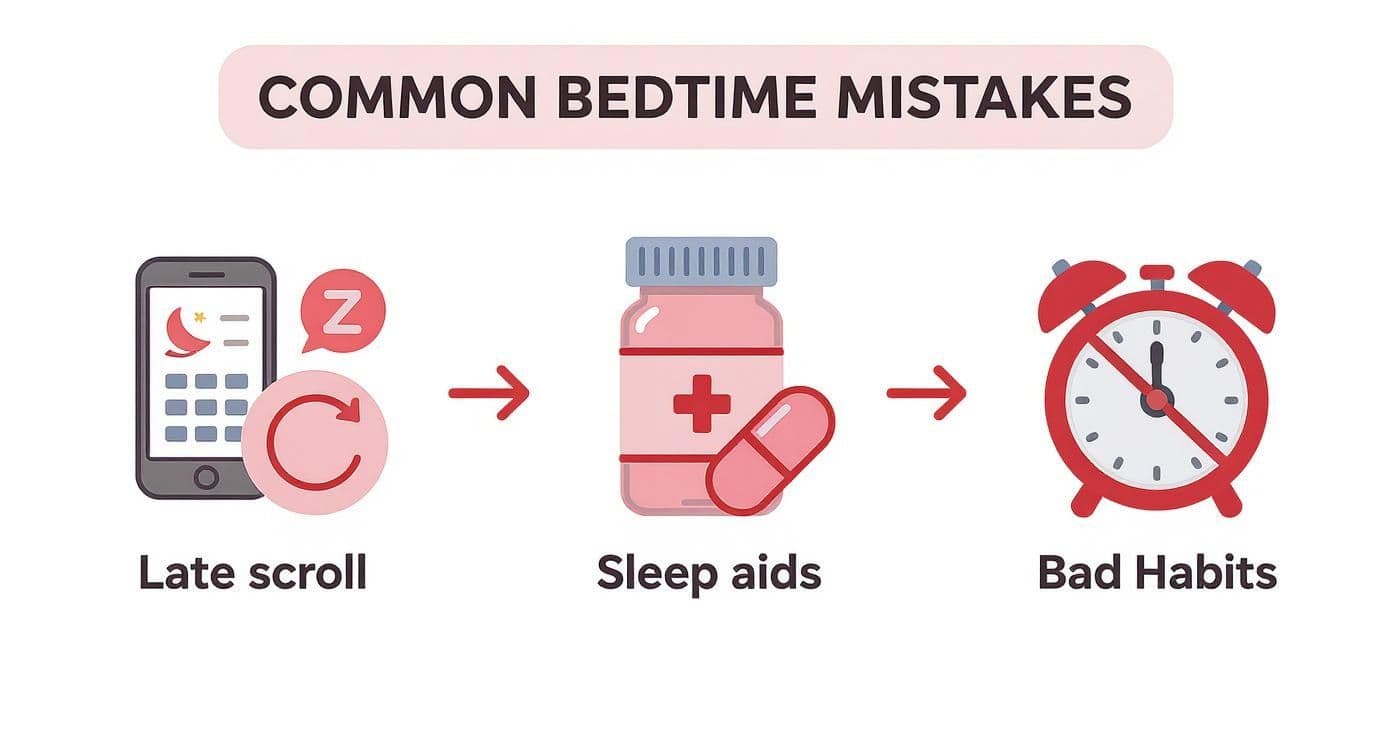
The image above really highlights how easily one bad habit can spiral into another, creating a vicious cycle that works directly against your body's natural sleep drive.
The most effective wind-down ritual is one you can perform almost automatically, without adding more decisions or stress to your evening. Start small—maybe with just one or two activities—and build from there as the habit becomes second nature.
For a deeper dive into crafting the perfect pre-sleep ritual, you can explore more ways to wind down before bed right here on our blog.
As you put together your ideal evening, think about weaving in specific techniques to help you drift off. These five effective tips for going to sleep quicker are a great place to find inspiration. And remember, it can take a few days for your body to adjust. Be patient with yourself and give yourself some grace as you find your rhythm.
The Power of a Consistent Sleep Schedule
While the activities you choose for your wind-down are important, the single most powerful tool for better sleep is simply this: consistency.
Your body is a creature of habit. It runs on a surprisingly precise internal 24-hour clock known as your circadian rhythm. This master clock is in charge of just about everything, from your energy levels to your hormone production, and it works best when it knows exactly what to expect.
Going to bed and waking up at roughly the same time every single day—and yes, I’m looking at you, weekends—is the most effective way to strengthen this internal rhythm. When your schedule is predictable, your brain learns to anticipate sleep. It begins releasing sleep-promoting hormones like melatonin right on cue, making falling asleep feel less like a struggle and more like a natural, effortless transition.
Training Your Internal Clock
Think of it like training a muscle. Every time you stick to your sleep schedule, you’re doing another rep, reinforcing the signal to your body. Over time, this makes any bedtime routine you build far more effective because you'll start to feel naturally drowsy as your designated bedtime approaches.
This isn’t just a nice idea; it’s backed by solid science. Research consistently shows that adults with a regular sleep-wake schedule report significantly better sleep. One study even found that people with a consistent routine were 30% more likely to fall asleep within 30 minutes. If you’re curious about the data, you can read the full research on sleep consistency and its benefits to see just how impactful this one habit can be.
Of course, life has a funny way of getting in the way of our best-laid plans.
Weekends are often the biggest culprit in derailing a solid sleep schedule. Staying up late and sleeping in on Saturday can create a form of 'social jetlag,' making it incredibly difficult to get back on track for the week ahead.
So, how do you build consistency without feeling like you're living in a military barracks? It's more achievable than you think.
Here are a few practical strategies that actually work:
Set a Bedtime Alarm: We all use an alarm to wake up, but have you ever tried one for going to bed? Setting an alarm for 30-60 minutes before you want to be asleep is a brilliant cue. It's your official signal to stop what you're doing and begin your wind-down ritual.
Embrace the 60-Minute Rule: On weekends or holidays, try not to deviate from your normal bedtime or wake-up time by more than an hour. A little flexibility is fine, and this small buffer won't be enough to throw your circadian rhythm completely off course.
Prioritize Your Wake-Up Time: If you know your bedtime is going to be a bit erratic, focus on waking up at the same time each morning. A consistent wake-up time is the strongest anchor you can give your internal clock. For a more detailed guide on this, check out our post on how to create a sleep schedule that fits your life.
Taming a Racing Mind with Audio Stories
Does your head hit the pillow only for your brain to start replaying every awkward conversation you’ve ever had? It’s a special kind of frustration when all you want is rest, but your mind is running a marathon of its own.
When that mental chatter won't quit, giving it a gentle, new focus can make all the difference. This is where a calming audio story comes in. It offers your brain just enough to latch onto, gently leading it off the hamster wheel of daily anxieties.

Instead of fighting your thoughts—a battle you’ll rarely win—you’re simply giving them a more peaceful path to follow. It’s a surprisingly effective way to shift your mental state from stressed and buzzing to relaxed and ready for sleep.
Creating Your Ideal Audio Sanctuary
Making narrative audio a part of your wind-down ritual is wonderfully simple. The goal is to create an immersive, calming experience that turns your bedroom into a true sanctuary from the noise of the day.
Here’s how to fold it into your routine seamlessly:
Choose Your Escape: What does your mind need tonight? A gentle fantasy to get lost in? A quiet myth to ponder? Let your mood guide you. Picking a story that feels like a warm blanket is the most important part.
Layer Your Soundscape: One of the best features in apps like Otherworld Tales is the ability to mix in ambient sounds. Layering the soft patter of rain or a gentle breeze over the narrator’s voice deepens the sense of calm and helps block out those little household noises that can pull you out of the moment.
Set a Sleep Timer: This is non-negotiable. Seriously. Setting a timer to fade the audio out after 30 or 45 minutes gives you full permission to drift off. You won’t have to worry about the story playing all night or waking up to a dead phone battery.
This small ritual can transform your pre-sleep experience from a battleground into a cherished moment of peace.
Imagine this: You've had a stressful workday. Instead of letting thoughts about deadlines and emails follow you to bed, you cue up a tale about a mystical forest. You mix in the sound of a crackling fire. Soon, the narrator's voice has replaced the lingering anxieties. This isn't just a distraction; it’s a deliberate act of mental recalibration.
Why Narrative Audio Just Works
Listening to a story demands a different kind of attention than staring at a screen. It engages your imagination without the stimulating blue light that we all know messes with our natural melatonin production.
You can learn more about the unique power of bedtime stories and audio for adults in our detailed guide.
Ultimately, the goal is to find a tool that makes your bedtime routine feel like a reward, not another chore. By swapping anxious thoughts for a well-told story, you give yourself a gentle, reliable path to a good night's sleep.
Troubleshooting Common Sleep Challenges

Even with the perfect bedtime routine, some nights are just plain difficult. It happens to all of us. You might jolt awake at 3 a.m. with your mind buzzing, or find it impossible to quiet your thoughts after a stressful day.
This isn’t a sign that your routine has failed. It’s just a normal part of being human.
Instead of fighting the frustration, think of these nights as a time to pull a few different tools out of your sleep kit. Having some go-to strategies for challenging nights helps you gently guide yourself back toward rest without adding more stress to the pile. The key is to respond calmly, not with panic.
When Your Mind Just Won’t Stop
A racing mind is probably the most common sleep thief out there. When you’re stuck in a loop of worries, to-do lists, or just replaying the day’s conversations, you need a way to break that cycle. A simple "worry journal" kept by your bedside can be a surprisingly powerful ally.
Just take a few minutes to jot down everything that's swirling around in your head. The simple act of getting it out of your mind and onto the page can feel like a huge relief. You’re giving yourself permission to park those thoughts until morning, telling your brain that they’ve been noted and you can safely let them go for now.
Another fantastic technique is focused breathing. The ‘4-7-8’ breathing method is especially calming:
Inhale quietly through your nose for a count of four.
Hold your breath for a count of seven.
Exhale completely through your mouth with a whoosh sound for eight.
Repeat this cycle three or four times. It works like a natural tranquilizer for the nervous system, slowing your heart rate and forcing your mind to focus on a simple, rhythmic task.
The Paradox of Staying in Bed
Here’s a counterintuitive one: if you've been lying awake for more than 20 minutes, get out of bed. It feels wrong, but staying put while trying to force sleep only teaches your brain to associate your bed with frustration and wakefulness.
Get up and go to another room with dim lighting. Do something quiet and boring—read a few pages of a dull book, listen to some soft music, or sip a bit of herbal tea. Don’t return to bed until you feel genuinely sleepy again. This "reset" helps break the cycle of insomnia and reinforces your bed as a place for sleep, not struggle.
When sleep feels elusive, the goal shouldn't be to fight harder for it. The most effective approach is often to surrender to the wakefulness for a short period, engage in a calming activity, and allow drowsiness to return naturally.
These challenges are universal, but how we handle them can vary. Sleep patterns differ wildly across the globe due to culture and lifestyle. For example, adults in Singapore get an average of just 7 hours and 24 minutes of sleep, while those in the U.S. and U.K. get closer to 8 hours.
These differences just go to show that while building a bedtime routine is a personal journey, the struggle for quality rest is something we all share. You can discover more interesting facts about global sleep patterns on NapLab.com.
Your Questions About Bedtime Routines Answered
Even when you're completely on board with creating a better bedtime routine, practical questions always come up. It's only natural to wonder about the specifics as you start building a new habit.
Getting those questions answered can mean the difference between a routine that sticks and one you give up on after a few nights. Let's dig into some of the most common ones.
How Long Should My Bedtime Routine Be?
While there's no single magic number, most people find their sweet spot somewhere between 30 and 60 minutes. This gives your mind and body enough runway to properly transition from the day's stress into a state of genuine rest.
Had a particularly rough day? Don't be afraid to extend it to 90 minutes. That extra time can be incredibly restorative when you feel frazzled. The most important thing, though, is consistency. Pick a duration you can realistically stick with so it doesn't just feel like another chore on your to-do list.
What If My Schedule Prevents a Consistent Bedtime?
Life happens. Shift work, family obligations, and late nights are a reality for many of us, making a fixed bedtime feel impossible. If that’s you, switch your focus to keeping your wake-up time the same every single day—yes, even on weekends.
Believe it or not, this is far more powerful for anchoring your internal body clock (your circadian rhythm) than a strict bedtime is. On those nights you have to be up late, just do a condensed version of your routine. Even 15 minutes of a familiar, calming activity can send a strong signal to your body that sleep is on the way.
A consistent wake-up time is the anchor for your circadian rhythm. Even if your bedtime drifts, waking up at the same time each morning helps your body anticipate sleep and regulate your energy levels throughout the day.
Can I Use My Phone for Reading or Listening?
This is a big one. Using your phone to read in bed is a gamble, mainly because of the blue light it emits, which is notorious for messing with your body's melatonin production. If you absolutely have to, make sure to use your phone’s “night mode” and drag the brightness slider all the way down.
Where your phone really shines, however, is for listening to audio stories or calming sounds. The trick is to avoid getting sucked into stimulating apps like social media or your work email. The goal is to set it and forget it.
Here’s how to do it right:
Pick Your Audio First: Decide on your story or soundscape before you get comfortable in bed. This prevents that last-minute, sleep-killing scroll.
Set a Sleep Timer: Using an app with a built-in sleep timer, like Otherworld Tales, is perfect. It ensures the audio fades out after you've drifted off so it doesn't disturb you later.
Go Screen-Free: Once your audio is playing, put your phone face down. Make a pact with yourself not to pick it back up. Just listen.
Ready to make calming audio stories a part of your wind-down? Otherworld Tales offers a library of immersive stories designed to quiet your mind. Mix in relaxing sounds like rain or a crackling fire and set a sleep timer to drift off peacefully. Discover your new favorite tale at https://www.otherworldtales.com.